Parkinson's Treatment in Abilene
Your handwriting got smaller, your steps got shorter, and nobody told you that the shrinking is the part physical therapy can push back on.
What causes Parkinson's?
Parkinson's comes from the gradual loss of cells in the brain that produce dopamine, the chemical that helps set the size and speed of your movement. Physical therapy does not stop that process and we will not pretend otherwise. What it does change is the part you live with every day: how big your steps are, how steady you are turning in the kitchen, whether you can get out of a low chair, and how often you end up on the floor. Every one of those is trainable.

The most disabling feature of Parkinson's is not the tremor. It is that everything gets smaller and slower. Steps shorten, handwriting tightens, the voice drops, the arms stop swinging. What makes it hard to fight is that your internal gauge shrinks with it, so a small step feels like a normal step to you while everyone around you sees the difference. Resetting that gauge is the entire premise of amplitude training: practise movement that feels exaggerated until normal sized movement feels normal again.
Muscle tone stays switched on when it should be letting go, so the trunk, hips and shoulders stiffen. Rotation is usually the first casualty, which is why turning becomes a series of small shuffling steps instead of one smooth pivot, and why rolling over in bed turns into a project. Rigidity also pulls posture forward into a stoop, which puts your weight ahead of your feet and makes every balance problem worse. Daily mobility work is what keeps this from setting.
The automatic reactions that catch you when you stumble get slower and smaller with Parkinson's. You lose the quick corrective step that would normally save you, and because your posture already carries you forward, the recovery has to happen in less space than it used to. Falls are the single biggest threat to staying independent with this diagnosis. Balance training, specific stepping reactions, and rehearsing the moments where people actually fall are all trainable skills.
Your feet stick to the floor and will not go, usually at the worst possible moment: a doorway, a turn, a tight space, or the moment you hurry for the phone. Freezing is frightening because it strikes while you are already moving and it often ends in a fall. It responds to cueing rather than to effort. Counting out loud, a rhythm, a line on the floor, a deliberate weight shift, all give the movement system an external timing signal to work from.
Walking is one of the earliest things to change and one of the easiest to measure. The stride shortens, one arm stops swinging, the feet begin to drag, and speed drops off. Walking speed is closely tied to fall risk and to how far you can go on your own, so it is something we time and track rather than eyeball. Deliberate, large amplitude gait practice restores a meaningful share of it, and it holds as long as the practice continues.
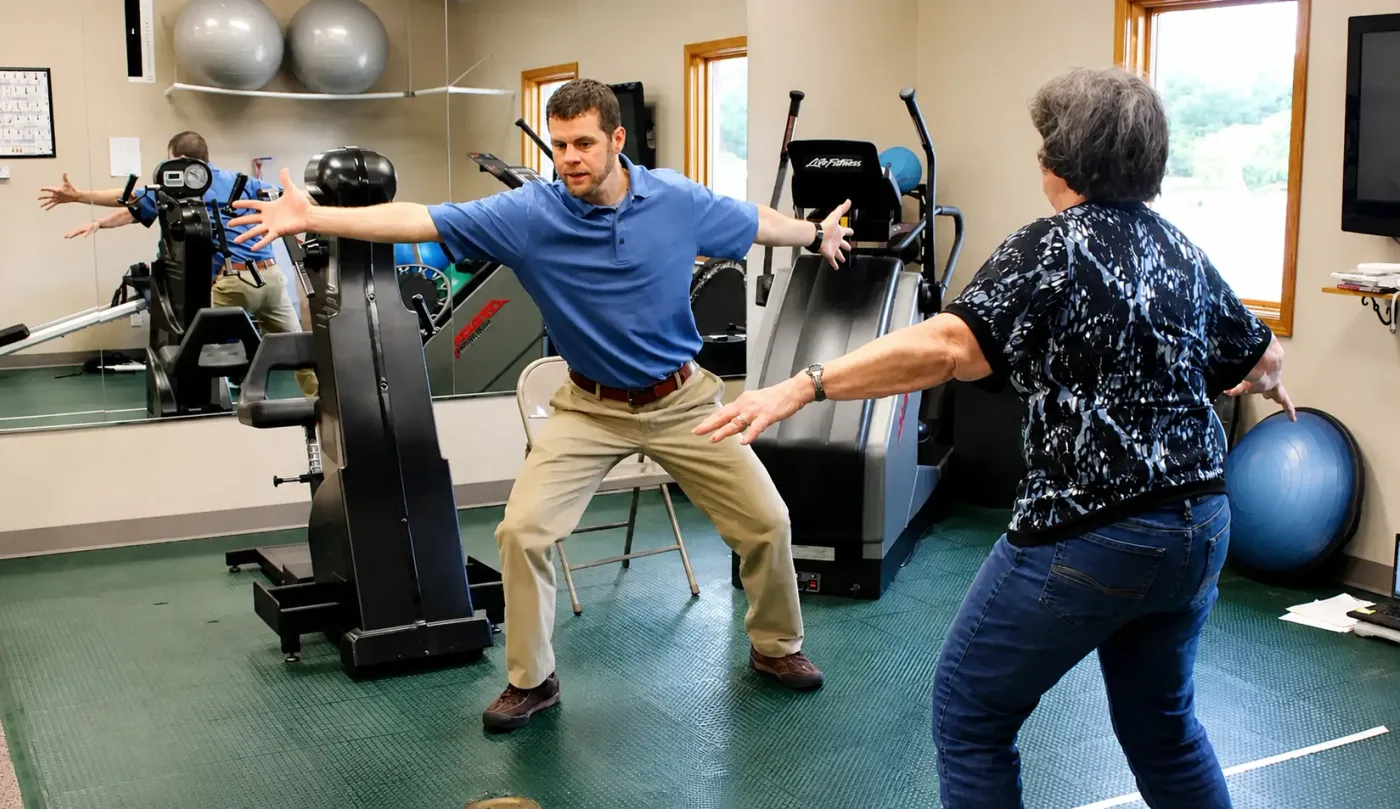
How physical therapy in Abilene helps.
Dr. Adam Burns and Karley Loewen are both LSVT BIG certified, the training protocol built specifically for Parkinson's. It runs on one principle: practise movement at an amplitude that feels far too big, repeatedly and intensively, until the calibration resets and normal sized movement stops feeling like effort. This is not gentle range of motion work. It is demanding, it is high effort, and it is done one on one with your therapist, start to finish. The results people notice are the ordinary things. Getting off the couch on the first try. Reaching the top shelf. Turning in the bathroom without a hand on the wall.
Around that we build the rest: balance and fall prevention, trunk rotation and posture work, leg strength for the muscles you stand up with, and gait training with cueing strategies you can actually use when you freeze. We measure walking speed, sit to stand and balance at the start and re-measure as we go, so you and your family can see where things stand rather than argue about it. Parkinson's changes over time and the plan changes with it. Many people come back for a tune up when they notice the movement shrinking again, and that is exactly the right moment to come rather than waiting.
What to expect from your recovery.
Measure what you can actually do
Your first visit is measurement. Walking speed and stride, how long it takes you to stand from a chair, how you turn, where your balance gives out, and what you have quietly stopped doing at home. Those numbers become the baseline we keep returning to, so progress is visible to you and to your family instead of being a matter of opinion.
Amplitude training, done properly
LSVT BIG runs as an intensive block of one on one sessions with daily practice in between. You will feel like you are moving far bigger than necessary, and that is exactly the point. Alongside it we train balance, trunk rotation and leg strength, and we rehearse the transitions where falls actually happen.
Keep it, and come back when it slips
Amplitude fades if it is not practised, so you leave with a home program short enough to survive a real week. We show your family how to cue you, we re-measure, and we plan a check in. When you notice your steps shrinking again, that is the moment to call us at (785) 263-3646.
My husband has always enjoyed his experience with the crew in Chapman. He will be returning soon for help with his balancing.
Movement problems rarely travel alone.
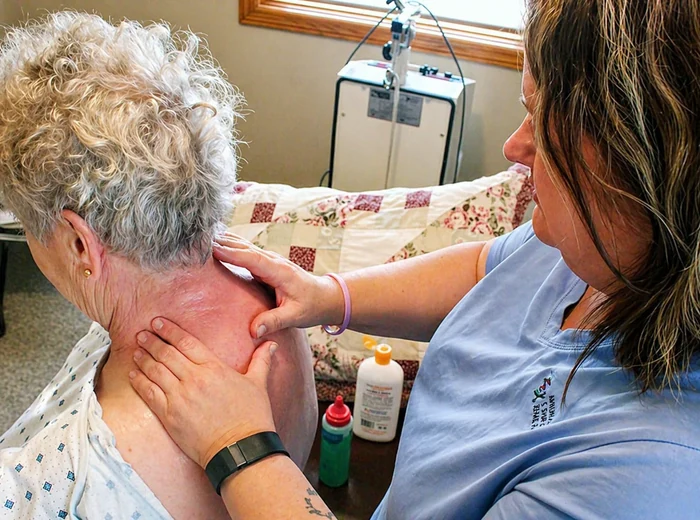
Back Pain & Sciatica
A stooped posture and a trunk that has stopped rotating load the low back hard. We treat the back and the rotation together.

Chronic Pain
Rigidity and reduced activity leave a lot of people aching everywhere. Graded loading and honest measurement, not more rest.

Neck Pain
A head carried forward of the shoulders keeps the neck under constant load. Mobility and strength work eases the stiffness.